Project Butterfly

Raising monarchs,
one egg at a time

Every year our young children raise monarchs. They collect eggs from milkweed, patiently raise them indoors, observe all of the stages, and release each one into our garden after it emerges as a butterfly.

Join us on our educational journey

Monarchs are a threatened species and we are happy to help in the ways that we can to help preserve the population. Join our children and their able assistants (their parents!) on our educational journey and conservation efforts, and enjoy our videos. We hope you learn as much as we did!

1 Stage 1: Egg

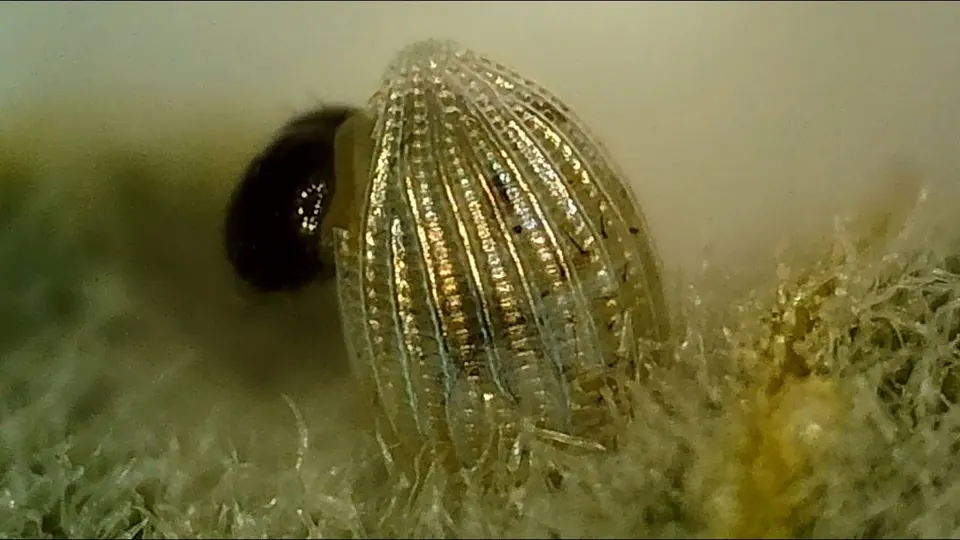
Monarch Caterpillar Hatching

We hunt for tiny eggs on the undersides of milkweed leaves. Each one is about the size of a pinhead.

A monarch caterpillar hatching from its egg and exploring its new world. Its very first meal? Its own eggshell.
2 Stage 2: Caterpillar

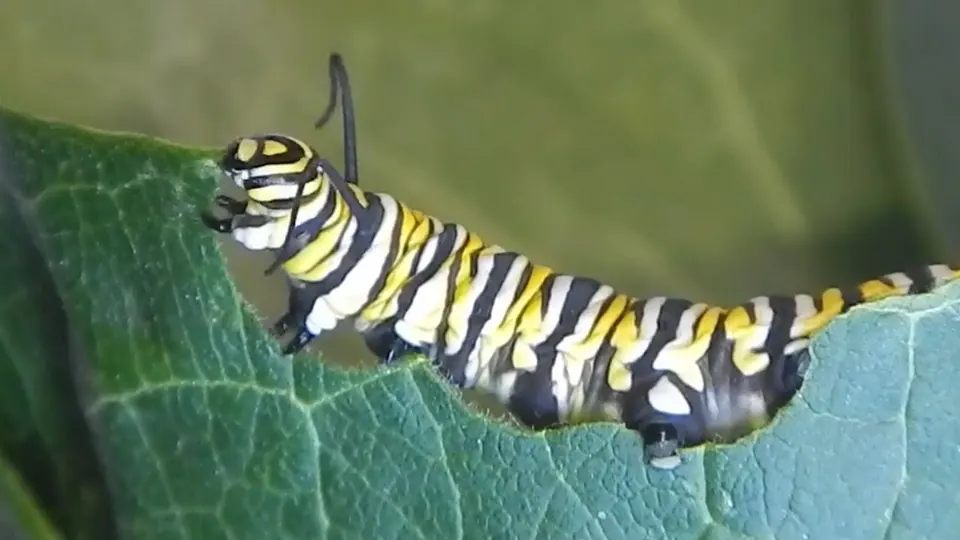
Monarch Caterpillar Eating

Caterpillars are very hungry. They increase their mass by 2,000 to 3,000% in just two weeks.

This video is of a 5th instar caterpillar eating. That's it! (Well, with some lovely music for you to listen to.) Watch the mechanics of the eating, the movement through the leaf, and the speed. It easily eats its own body length in milkweed.

3 Stage 3: Chrysalis

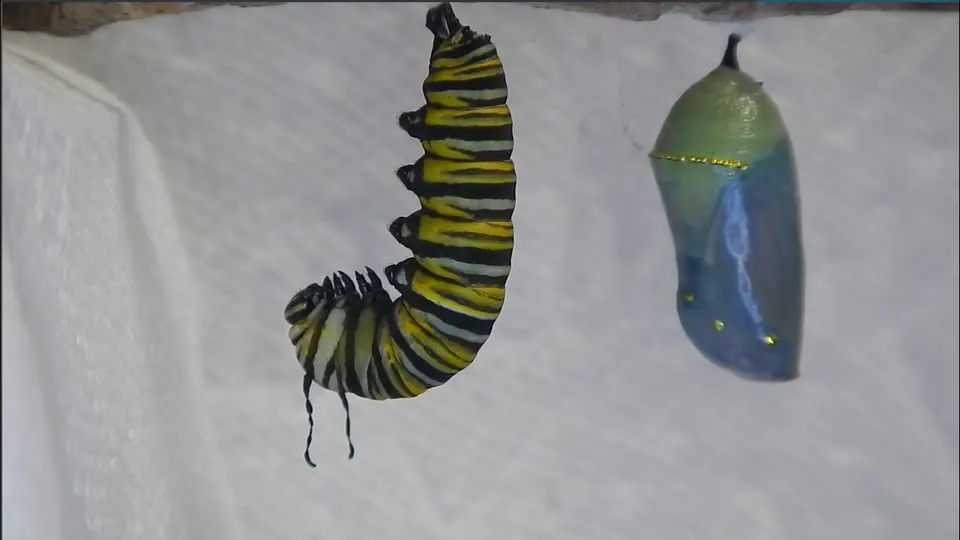
Monarch Caterpillar Metamorphosis into a Chrysalis

The caterpillar hangs upside down in a ā€œJā€ and transforms into a jade-green chrysalis with gold dots.

The metamorphosis from a monarch caterpillar into a butterfly happens during the pupa, or chrysalis, stage. The caterpillar hangs upside down from a branch, hidden in leaves.

4 Stage 4: Butterfly

Monarch Butterfly Eclosion

Out comes a butterfly! It pumps its wings full, lets them dry, and then we release it into our garden.

The process of a butterfly emerging from its chrysalis is called eclosion.

Monarch quiz

Put your knowledge to the test

We have learned so much about monarchs through our experiences raising them. They are an interesting butterfly! Enjoy this quiz of fun facts and trivia about the monarch caterpillar and monarch butterfly.

Have an idea for a question for a future monarch quiz? Let us know in the YouTube comments!

Take the quiz

Meet the butterflies

Every butterfly gets a name

Some flew off into the garden. A couple with crumpled wings stayed with us as pets. Here are a few of our favourites.

Bella the Beautiful, a monarch butterfly

Female

Bella the Beautiful

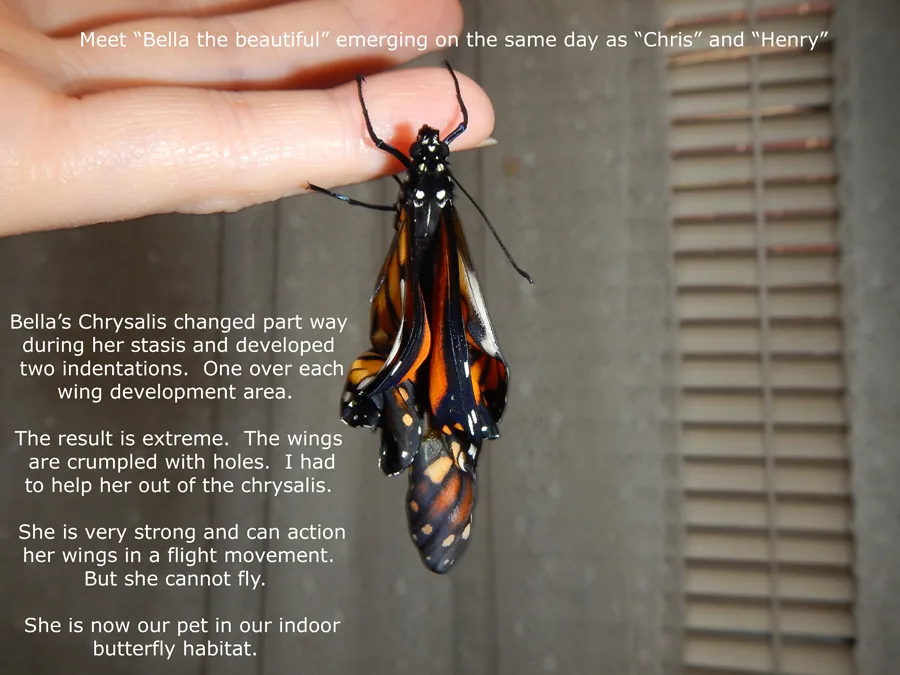
Her chrysalis changed partway through and her wings came out crumpled. She is very strong and can flap, but she cannot fly, so she became our pet in an indoor butterfly habitat.

Courageous Chris, a monarch butterfly

Male

Courageous Chris

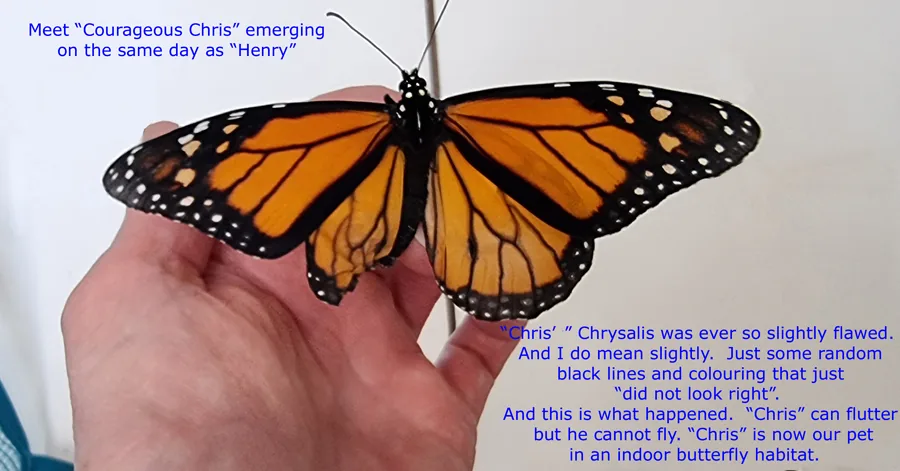
Emerged the same day as Henry. His chrysalis was ever so slightly flawed, so Chris can flutter but not fly. He lives in our indoor habitat too.

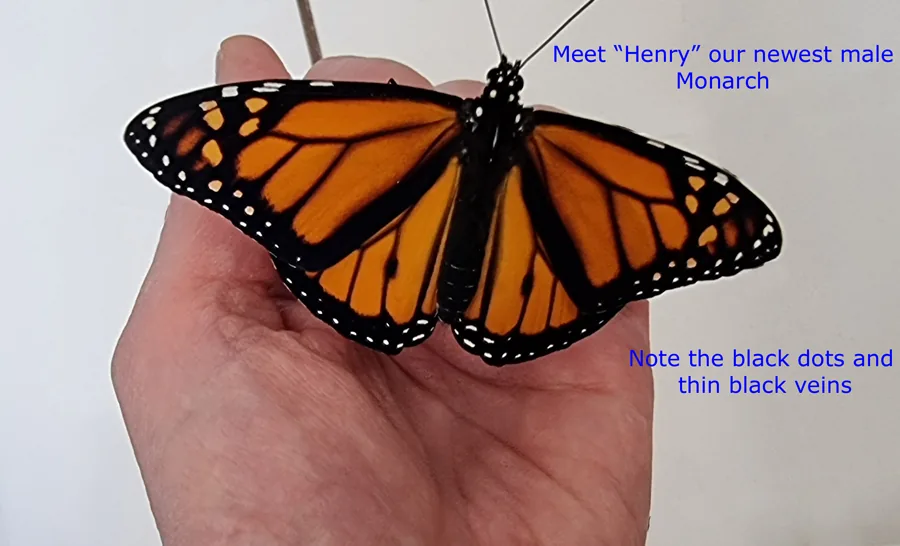
Henry, a monarch butterfly

Male

Henry

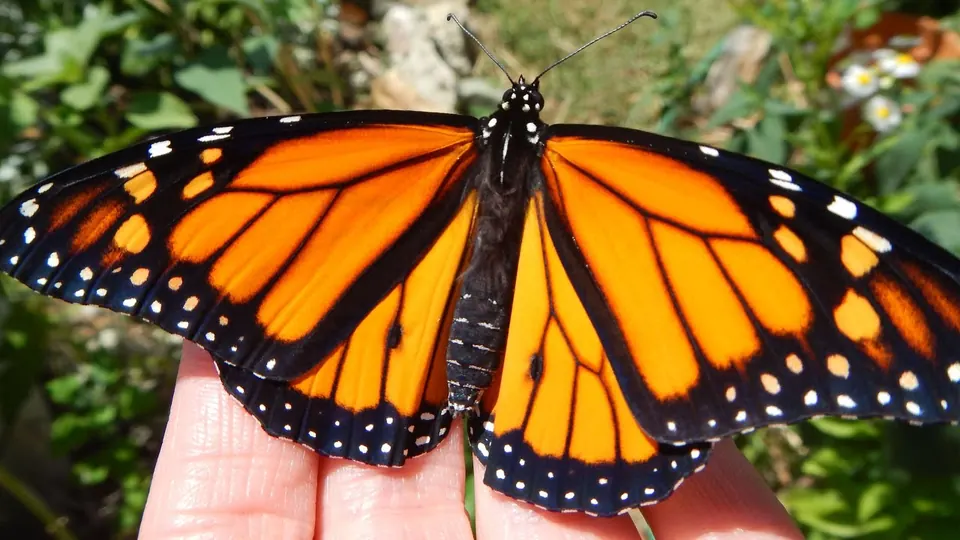
Our newest male monarch. Note the black dots and thin black veins that tell you he's a boy.

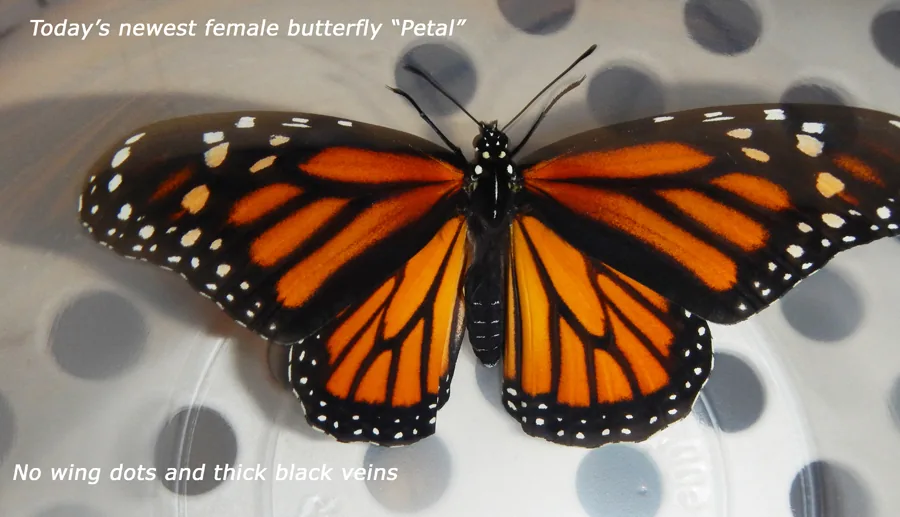
Petal, a monarch butterfly

Female

Petal

Our newest female butterfly. No wing dots and thick black veins: a classic girl monarch.

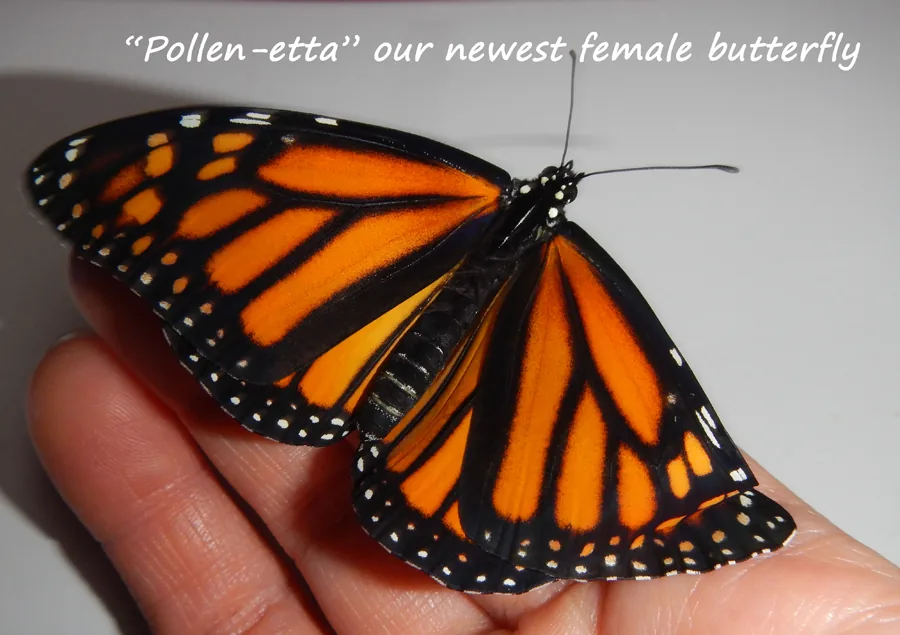
Pollen-etta, a monarch butterfly

Female

Pollen-etta

Our newest female butterfly, posing for her portrait.

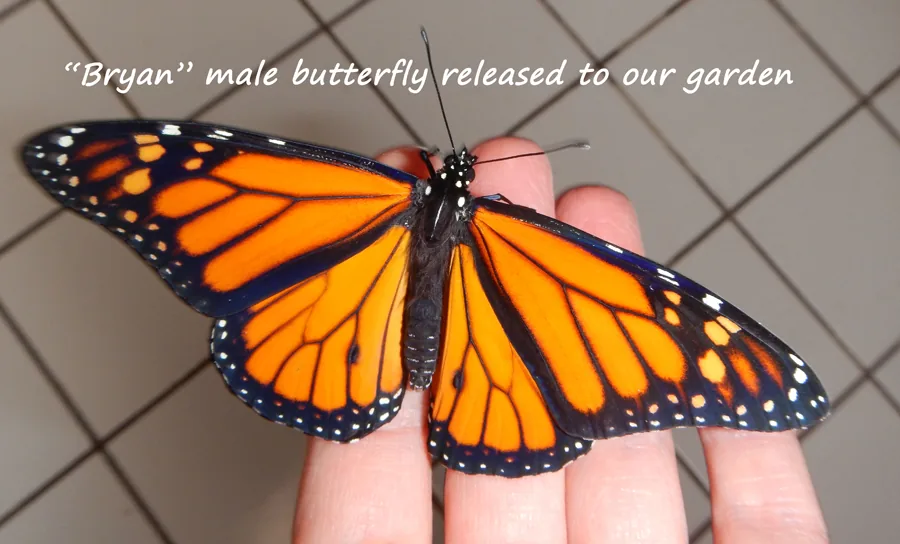
Bryan, a monarch butterfly

Male

Bryan

A male butterfly, released into our garden.

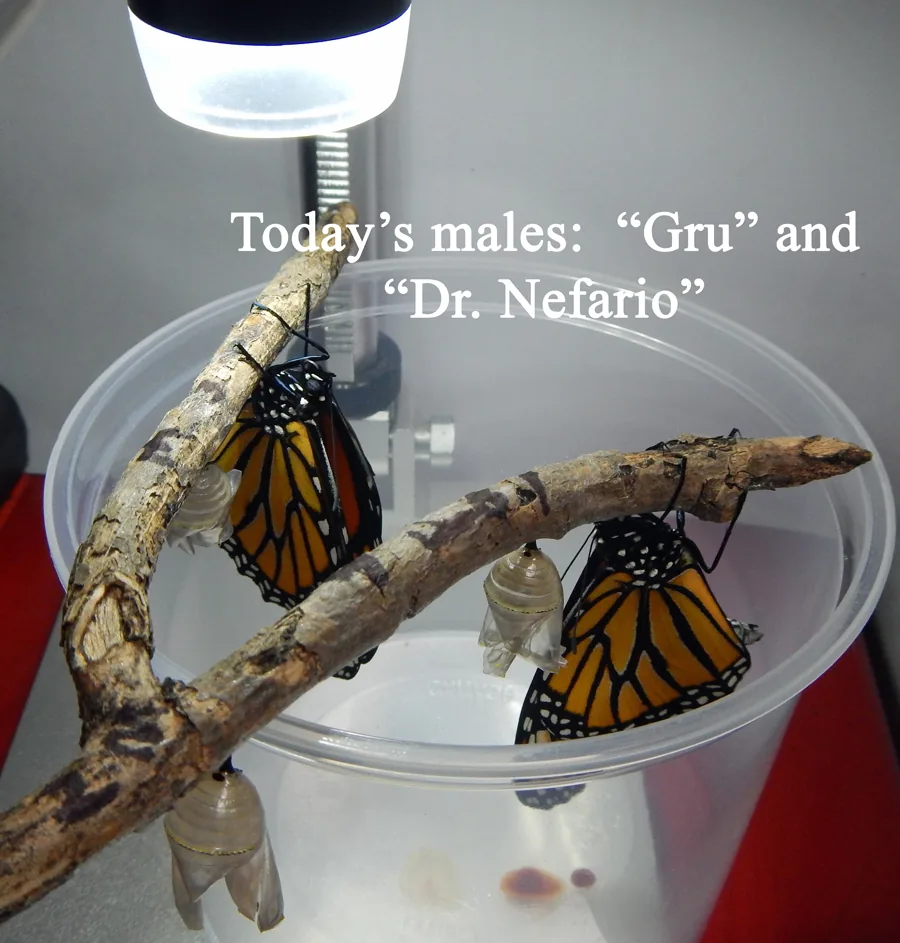
Gru & Dr. Nefario, a monarch butterfly

Males

Gru & Dr. Nefario

Two males who emerged on the same day, drying their wings side by side.

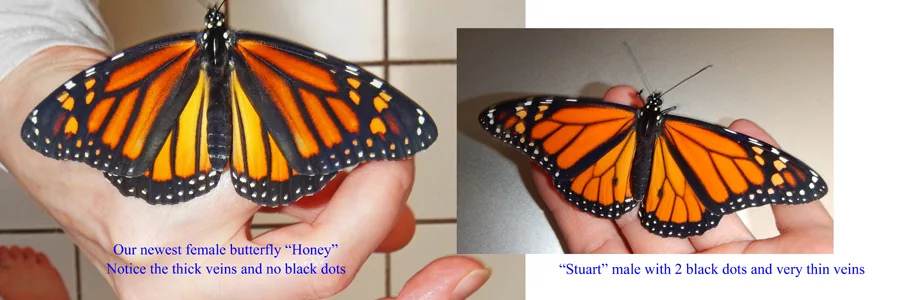
Honey & Stuart, a monarch butterfly

Female & male

Honey & Stuart

Honey has thick veins and no black dots. Stuart has two black dots and very thin veins. Can you spot the difference?

Endangered monarch

Monarchs are now listed as Endangered

The migratory monarch butterfly (Danaus plexippus plexippus), known for its spectacular annual journey of up to 4,000 kilometres across the Americas, has entered the IUCN Red List of Threatened Species as Endangered, threatened by habitat destruction and climate change.

  • 99.9%The western population declined from as many as 10 million to 1,914 butterflies between the 1980s and 2021.
  • 84%The larger eastern population also shrank by 84% from 1996 to 2014.
  • 4,000 kmConcern remains whether enough butterflies survive to keep the great migration going.

“It is difficult to watch monarch butterflies and their extraordinary migration teeter on the edge of collapse, but there are signs of hope. So many people and organisations have come together to try and protect this butterfly and its habitats. From planting native milkweed and reducing pesticide use to supporting the protection of overwintering sites and contributing to community science, we all have a role to play in making sure this iconic insect makes a full recovery.”

Anna Walker, IUCN SSC Butterfly and Moth Specialist Group, who led the monarch butterfly assessment. Read the IUCN press release

How your family can help

  • Plant native milkweedIt's the only food monarch caterpillars eat.
  • Reduce pesticide useKeep gardens safe for caterpillars and butterflies.
  • Protect overwintering sitesSupport the forests where monarchs spend the winter.
  • Join community scienceCount and report the monarchs you see.

New videos are hatching all the time

Subscribe to MacNeill MADE on YouTube so you never miss a butterfly, a math trick, or a stop-motion adventure.

Subscribe